
Under Armour is known for its performance-driven gear — but behind that success is a global supply chain that many new brands want to understand.
As someone who works closely with activewear OEM factories, I’m often asked:
- “Where does Under Armour actually manufacture its apparel?”
- “Can smaller OEMs compete with such a large, established supply chain?”
This article breaks everything down in a simple, practical, and brand-friendly way.
Table of Contents
- Quick Answer
- 1. Where Under Armour Manufactures Its Gear
- 2. What Under Armour Looks for in Its Supplier Network
- 3. How OEMs Can Compete With Under Armour’s Supply Chain
- 4. Comparison Table: UA vs. OEM Advantages
- 5. Practical Advice for New or Growing Brands
- FAQs
- Partnering With FuKi Gymwear
Quick Answer
Under Armour manufactures its gear mainly in Vietnam, China, Jordan, Indonesia, and the Philippines.
These regions provide technical fabrics, high-capacity production, and consistent quality control.
From my OEM experience, smaller manufacturers still have strong competitive advantages — especially in faster sampling, lower MOQs, and more flexible development cycles.
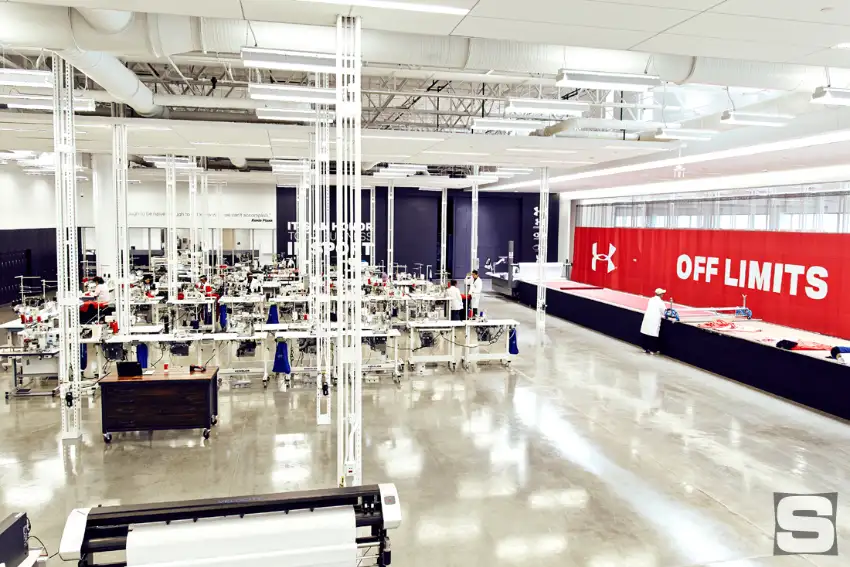
1. Where Under Armour Manufactures Its Gear
Under Armour relies heavily on outsourced manufacturing, not self-owned factories.
🌍 Global Manufacturing Footprint (2025)
| Region | Country | Key Strength |
|---|---|---|
| Asia | Vietnam | Main hub for activewear, leggings, and tees |
| Asia | China | Advanced fabrics + skilled technical sewing |
| Middle East | Jordan | Large-scale garment production |
| Asia | Indonesia | Performance knits & cut-and-sew |
| Asia | Philippines | Stable labor force + sportswear focus |
💬 From my factory experience:
Vietnam and China still dominate because they have the strongest performance-fabric ecosystems.
2. What Under Armour Looks for in Its Supplier Network
UA’s supplier requirements are strict — but they reveal useful insights for OEM factories.
| Requirement | What It Means | Why It Matters |
|---|---|---|
| Performance fabric capability | Compression, HeatGear, ColdGear materials | UA builds technology-based apparel |
| Quality consistency | Stable stitching & QC systems | Reduces rejections and delays |
| Production scale | High volume, predictable output | Supports global distribution |
| Compliance & certifications | WRAP, BSCI, sustainability audits | Ensures brand safety & trust |
💬 Most small OEMs lose not because of fabric or sewing, but because they can’t meet documentation or compliance requirements.
3. How OEMs Can Compete With Under Armour’s Supply Chain
Despite UA’s scale, smaller OEMs still hold major advantages:
✅ 1. Faster Sampling Speeds
Big suppliers move slowly; small OEMs can deliver samples in 5–10 days.
✅ 2. Flexible MOQs
UA-level factories rarely accept small runs.
OEMs can stand out with 100–300 pcs minimums.
✅ 3. Trend-Responsive Development
UA is strong in tech, but slower in lifestyle trends.
OEMs can win by producing athleisure, comfort-first, and influencer-driven pieces quickly.
✅ 4. Personalized Communication
Small OEMs win clients by offering direct support, faster revisions, and real-time feedback.
💬 From my OEM work:
Brands don’t always want the biggest factory — they want the fastest, most cooperative, and most flexible one.
4. Comparison Table: UA vs. OEM Advantages
| Feature | Under Armour Supply Chain | OEM Factory Advantages |
|---|---|---|
| Speed | Slower due to scale | Fast sampling & reactions |
| MOQ | Very high | Low & flexible |
| Innovation | Strong technical fabrics | Flexible trend development |
| Communication | Layered & formal | Direct, quick, responsive |
| Cost | Higher | More competitive |
5. Practical Advice for New or Growing Brands
Here are my strongest recommendations:
- Start with small-batch testing, not big orders
- Choose factories that understand performance fabrics
- Prioritize fast sample validation cycles
- Build a long-term relationship with your OEM — not project-by-project
- Use data and customer feedback to guide each product iteration
💬 A great factory can save a weak product.
A weak factory can destroy a great product.
FAQs
Q1: Does Under Armour still manufacture in the U.S.?
Only prototype labs — not bulk production.
Q2: Are UA’s factories exclusive?
No, most are independent suppliers that also serve other clients.
Q3: Can smaller OEMs match UA quality?
Yes — especially with modern machinery and performance-fabric expertise.
Q4: What products are easiest for OEMs to compete on?
Leggings, performance tees, training shorts, and lightweight outerwear.
Partnering With FuKi Gymwear
If you want to build performance-focused activewear similar to global brands:
👉 FuKi Gymwear can support you with modern OEM capabilities.
Why Brands Choose Us
- 🚀 Fast sampling & low MOQs
- 🧵 Performance, seamless, brushed, and recycled fabrics
- 📦 Support for influencer drops & limited collections
- 🌱 Eco-friendly and sustainable material options
Your brand’s success depends on quality, speed, and reliability — and that’s exactly what we deliver.

