
When boutique fitness brands research how to launch their own activewear line, two names surface constantly in competitive analysis: SET ACTIVE and NVGTN. Both launched in 2018, both built on Instagram-fueled community growth, both turned limited-edition drops into eight-figure revenue machines -- yet their OEM production playbooks differ in ways that directly affect your sourcing decisions.
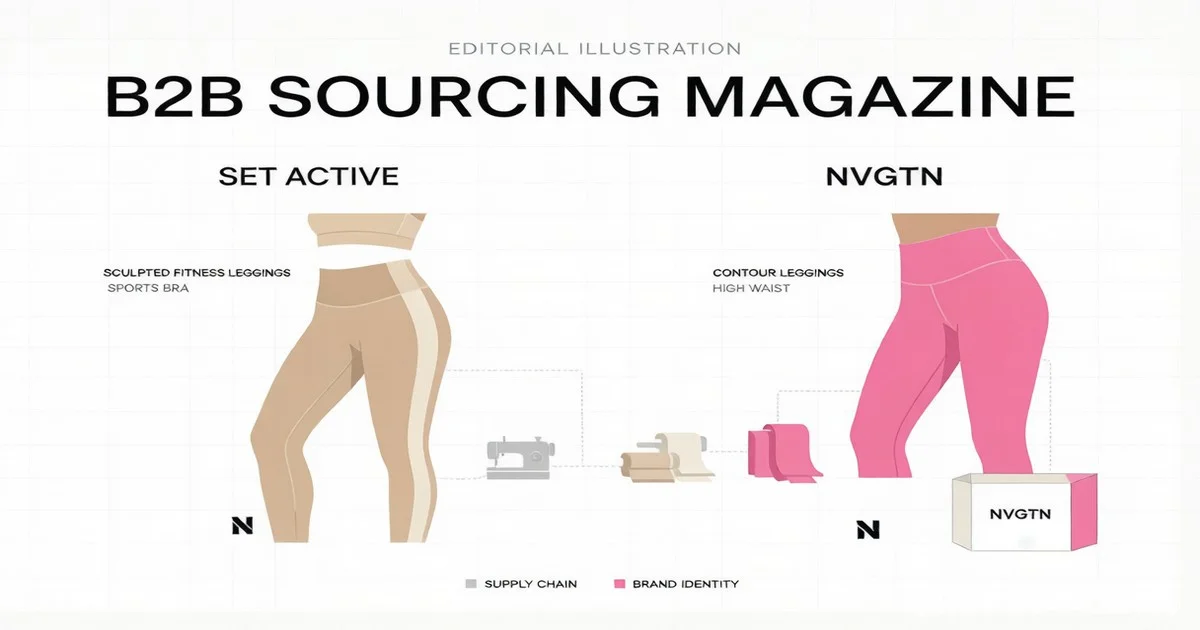
Table of Contents
- Brand Overview: Two DTC Heavyweights
- Product Anatomy: What Each Brand Actually Sells
- Fabric Strategy: Proprietary Blends vs Seamless Off-the-Shelf
- Manufacturing Footprint: Where Production Happens
- MOQ and Pricing: What OEM Partners Should Expect
- Supply Chain Structure: Drops, Inventory, and Lead Times
- Side-by-Side OEM Comparison Table
- How to Launch a Brand in Either Lane
- Common Questions About DTC Activewear OEM
Brand Overview: Two DTC Heavyweights
SET ACTIVE was founded by Lindsey Carter in Los Angeles without a single dollar of outside investment. By 2025, the brand was generating approximately $20 million in annual revenue -- entirely bootstrapped, entirely DTC. Carter's background in social media marketing shaped every aspect of the business: she tested fabric samples with her personal Instagram followers before the brand even had a name, and the company's viral color-drop model routinely sells $1 million worth of product within an hour of launch.
NVGTN (pronounced "navigation") followed a parallel path. Founded by Ashleigh and Brett Schneggenburger from their apartment in Florida, the brand built a TikTok and Instagram following that now spans customers in over 180 countries. NVGTN invested $15 million into a 100,000-square-foot headquarters and fulfillment center in Pasco County, Florida, and during product launches can process over 50,000 orders in a single window.
Both brands prove that DTC activewear can scale without wholesale or retail partnerships -- but their production DNA diverges sharply once you look under the hood.
Product Anatomy: What Each Brand Actually Sells
Understanding the product mix matters for OEM planning. The SKU complexity of each brand dictates the factory capabilities you will need.
SET ACTIVE's lineup revolves around matching sets built from five proprietary fabric families: Sculptflex for high-compression workouts, AirLuxe for breathable everyday wear, Formcloud for balanced support, Sportbody for moisture management, and Luxform for soft loungewear. The brand sells leggings, sports bras, biker shorts, sweats, tanks, and pullovers -- all in coordinated seasonal color palettes. Each drop typically introduces 8-15 SKUs across 4-6 colors.
NVGTN's catalog is more streamlined. The core revolves around three seamless legging silhouettes -- Contour Seamless ($50), Lift Seamless ($48), and Signature 2.0 ($48) -- plus matching shorts ($30-32), flare leggings ($48), and an everyday sweats line (hoodies at $50, sweatpants at $58). NVGTN launches new collections every two to three months with roughly 20-40 SKUs per drop, heavier on colorways than silhouette variety.
Fabric Strategy: Proprietary Blends vs Seamless Off-the-Shelf
This is where the two brands diverge most dramatically for OEM buyers.
SET ACTIVE developed proprietary fabric formulations with an Asian supplier, using a seamless circular knitting process that produces garments in a tubular configuration. Their Sculptflex fabric -- a 75% polyester / 25% spandex blend with strategically placed ribbing -- gives the brand its signature sculpting effect. For an OEM partner, this means you either need a factory with in-house circular knitting machines (like Santoni units) or a willingness to invest 8-12 weeks in custom fabric development with a mill. Budget at minimum $2,000-$5,000 for fabric R&D alone if you want a comparable proprietary feel.
NVGTN relies more on off-the-shelf seamless knit constructions that are widely available from Chinese and Southeast Asian factories. The Contour Seamless and Lift Seamless lines use nylon/spandex blends common in the seamless activewear supply chain. This is fundamentally easier to replicate for a new brand: you can find factories with Santoni seamless machines that already run similar constructions, meaning your sampling timeline drops to 4-6 weeks and fabric development costs drop to near zero if you accept stock yarns. The trade-off is less proprietary differentiation -- but at NVGTN's $48-50 price point, that is a feature, not a bug.
| Fabric Attribute | SET ACTIVE | NVGTN |
|---|---|---|
| Primary Construction | Proprietary seamless circular knit | Standard seamless knit (Santoni-type machines) |
| Key Composition | 75% Polyester / 25% Spandex | Nylon / Spandex blends |
| Proprietary Status | Yes -- Sculptflex, AirLuxe, Formcloud, Sportbody, Luxform | No -- uses widely available constructions |
| Fabric R&D Time (for replication) | 8-12 weeks | 2-4 weeks (stock yarns) |
| Estimated Fabric Cost/yd | $5.00-$8.00 | $3.00-$5.50 |
| OEKO-TEX Certification | Likely (supplied through Asian partner) | Supplier-dependent; verify per batch |
Manufacturing Footprint: Where Production Happens
According to WWD reporting, SET ACTIVE manufactures in China and Los Angeles. The Asian supply base handles the seamless knit production -- likely in Guangdong or Fujian province, where the majority of circular knit activewear capacity is concentrated -- while LA-based production likely covers cut-and-sew basics, sweats, and quick-turn replenishment. This dual-continent setup gives Carter's team flexibility: Asian production for cost efficiency on core leggings and bras, domestic production for speed on smaller runs.
NVGTN's manufacturing is less publicly documented, but the brand's product characteristics -- seamless knits with screen-printed or heat-transferred branding, standardized sizing, high-volume drop cadence -- strongly suggest a China-based supply chain. The $48-50 retail price point for leggings aligns with FOB costs in the $5.50-$7.50 range at MOQs of 5,000-10,000 units, which is standard for Guangdong or Fujian seamless factories running Santoni TOP2 FAST machines. NVGTN's 100,000-square-foot Florida facility handles warehousing and fulfillment, not production.
| Manufacturing Aspect | SET ACTIVE | NVGTN |
|---|---|---|
| Production Locations | China + Los Angeles, USA | China (primary, inferred from product profile) |
| Factory Type | Seamless knit specialist + domestic cut-and-sew | Seamless knit specialist |
| In-House Warehousing | Not publicly disclosed | 100,000 sq ft in Pasco County, FL |
| Certifications Expected | OEKO-TEX, potential GRS for recycled content | Supplier-dependent; verify BSCI, ISO 9001 |
MOQ and Pricing: What OEM Partners Should Expect
If you are planning to manufacture activewear that competes in the SET ACTIVE or NVGTN lane, here is what the numbers look like in 2026, based on current factory data from Guangdong and Fujian production hubs.
| Production Tier | MOQ (per style/color) | Unit Cost (FOB) | Typical Brand Fit |
|---|---|---|---|
| Stock Fabric + Logo | 100-300 pcs | $6.50-$9.00 | NVGTN-style entry level |
| Custom Color + Logo | 300-500 pcs | $5.80-$8.00 | Mid-tier DTC launch |
| Full OEM (Custom Fabric + Design) | 500-1,000 pcs | $5.50-$7.50 | SET ACTIVE-style proprietary approach |
| High Volume | 5,000+ pcs | $4.90-$6.50 | Established brands scaling SKUs |
The NVGTN path -- stock seamless constructions with your logo -- is the most capital-efficient entry point. You can launch with 3-4 styles at 100-300 pieces each, keeping the first production run under $10,000. The SET ACTIVE path requires a larger upfront commitment: custom fabric development alone adds $2,000-$5,000 and 8-12 weeks before you even see a sample. But the payoff is proprietary differentiation that competitors cannot easily copy. According to Sourcify China's 2026 activewear sourcing report, brands committing to 5,000+ units per style can achieve per-unit costs as low as $5.95, with standard payment terms of 30% deposit and 70% before shipment.
Supply Chain Structure: Drops, Inventory, and Lead Times
The drop model that both brands use has direct implications for OEM production planning.
SET ACTIVE operates on a scarcity-driven calendar. Collections are limited-edition; once a colorway sells out, it may never return. This model requires precise production forecasting -- order too little and you leave money on the table, order too much and you are stuck with dead stock that cannot be remarketed. For OEM partners, this means working with factories that can handle smaller, faster production runs (1,000-3,000 units per color) with 45-60 day turnaround from PO to delivery.
NVGTN runs a higher-volume version of the same strategy. With 50,000+ orders per launch window, their production batches are substantially larger. The brand restocks popular colorways more frequently than SET ACTIVE, suggesting a hybrid model: core colors run in larger batches (10,000+ units) while seasonal colors run in moderate batches (3,000-5,000 units). New brands following this model should plan for 60-75 day lead times from fabric procurement through quality inspection. The Yunenx activewear production guide recommends adding 10 buffer days for each approval step in the sampling-to-production pipeline.
| Production Phase | SET ACTIVE Style (Small Batch) | NVGTN Style (Volume Batch) |
|---|---|---|
| Fabric Development/Sourcing | 8-12 weeks (custom) | 2-4 weeks (stock) |
| Sampling & Fit Approval | 3-4 weeks | 2-3 weeks |
| Bulk Production | 4-6 weeks | 5-7 weeks |
| QC & Packing | 1-2 weeks | 1-2 weeks |
| Total Lead Time | 16-24 weeks | 10-16 weeks |
| Typical Batch Size | 1,000-3,000 units/color | 5,000-10,000+ units/color |
Side-by-Side OEM Comparison Table
| Dimension | SET ACTIVE | NVGTN |
|---|---|---|
| Founded | 2018, Los Angeles | 2018, Florida |
| Revenue (est.) | ~$20M annual | Not disclosed (50K+ orders/launch) |
| Manufacturing | China + Los Angeles | China (primary) |
| Fabric Strategy | Proprietary (5 fabric families) | Standard seamless (off-the-shelf) |
| Retail Price Range | $58-$98 | $30-$58 |
| Drop Frequency | Seasonal + limited color drops | Every 2-3 months |
| Certifications | Supplier-level (OEKO-TEX expected) | Supplier-level (verify per batch) |
| Funding | 100% bootstrapped | Self-funded, $15M HQ investment |
| OEM Barrier to Entry | High (custom fabric R&D required) | Moderate (stock constructions available) |
| Best For | Brands wanting proprietary fabric IP | Brands wanting fast, capital-efficient launch |
How to Launch a Brand in Either Lane
Based on the production profiles above, here is a practical launch roadmap for each approach.
The NVGTN Path (Fast Launch): Start with 3-4 seamless styles (leggings, shorts, sports bra, tank) using stock nylon/spandex constructions from a factory with Santoni circular knit machines. Apply your logo via heat transfer or silicone print. MOQ: 100-300 pieces per style. First production budget: $8,000-$12,000. Timeline: 10-14 weeks from factory selection to delivery. Focus your differentiation on branding, community, and color curation rather than fabric IP. This is the most common path for first-time activewear founders, and it works -- NVGTN proved you can build a nine-figure brand on accessible production.
The SET ACTIVE Path (Proprietary Differentiation): Allocate 6 months before your first sale. Partner with a factory that offers in-house fabric R&D, ideally one with OEKO-TEX or OEKO-TEX Standard 100 certification and experience developing custom blends for established brands. Budget $5,000-$10,000 for fabric development and sampling. Your first production run should target 500-1,000 pieces per style across 3-5 styles. Total pre-launch investment: $25,000-$50,000. The advantage: once your fabric is dialed in, competitors face a 16-24 week barrier to copying your hand feel and performance characteristics.
Whichever path you choose, prioritize factory certifications. WRAP certification ensures ethical manufacturing practices, GRS (Global Recycled Standard) validates recycled content claims if you market sustainable activewear, and BSCI or SEDEX audits cover social compliance. For any seamless activewear order, request an ISO 9001 quality management certificate from your factory. According to Statista's global sportswear market data, the activewear segment is projected to exceed $450 billion by 2028, and compliance documentation is increasingly a prerequisite for retail and marketplace access.
For a deeper understanding of how different activewear brands structure their OEM supply chains, see our earlier breakdown of Alo Yoga vs Vuori: Activewear OEM Manufacturing Guide and our analysis of Gymshark vs Alphalete: OEM Manufacturing Guide for Fitness Brands. Both articles provide additional context on how DTC activewear brands approach production at different price tiers.
Common Questions About DTC Activewear OEM
How Much Does It Cost to Launch an Activewear Brand Like SET ACTIVE or NVGTN
A fast-launch NVGTN-style approach starts around $8,000-$12,000 for 3-4 styles at minimum MOQs with stock fabric. A SET ACTIVE-style proprietary fabric approach requires $25,000-$50,000 including fabric R&D, sampling, and a larger first production run. Both figures exclude branding, photography, website development, and marketing spend.
Which Factory Type Is Best for Seamless Activewear Production
Look for factories running Santoni or Lonati circular knitting machines -- these are the industry standard for seamless activewear. Guangdong and Fujian provinces in China have the highest concentration of Santoni-equipped factories. Verify that your factory holds at minimum ISO 9001 quality certification and preferably OEKO-TEX Standard 100 for fabric safety.
Can I Manufacture Activewear in the United States
Yes, but with limitations. Los Angeles has a mature cut-and-sew activewear ecosystem (SET ACTIVE uses LA for part of its production), and domestic manufacturing eliminates import duties and reduces lead times. However, seamless circular knit production is almost exclusively based in Asia due to the capital cost of the machinery. Expect US-made cut-and-sew activewear to cost 2-3x more than China-sourced equivalents.
What Certifications Should I Require from My Activewear Factory
At minimum: ISO 9001 for quality management, OEKO-TEX Standard 100 for fabric chemical safety. If you market sustainable products, require GRS certification for recycled content. For EU market entry, add REACH compliance documentation. For US retail placement, WRAP or BSCI social compliance audits strengthen your vendor onboarding package.
How Long Does It Take from Factory Selection to First Delivery
For a stock-fabric approach (NVGTN style): 10-16 weeks total. For a custom-fabric approach (SET ACTIVE style): 16-24 weeks total. These timelines assume one round of sampling revisions. Add 4-6 weeks if your factory requires multiple fit adjustments or if you are developing a completely new fabric blend.
Is the Drop Model Sustainable for a New Brand Without an Audience
The drop model works because artificial scarcity drives urgency, but it only works if you already have demand. For a new brand, start with a small permanent core collection (2-3 styles, 2-3 colors each) to establish baseline revenue and customer feedback, then introduce limited drops once you have an engaged audience. Both SET ACTIVE and NVGTN built their communities organically before the drop model became their primary revenue driver.
