
Table of Contents
- Quick Answer
- What “Producing at Scale” Really Means
- My Experience Scaling Custom Leggings Production
- The Core Systems Behind Scalable Leggings Production
- Step-by-Step: How Custom Leggings Are Produced at Scale
- Factories Experienced in Scaled Leggings Production
- Comparison Table
- How to Decide If Your Brand Is Ready to Scale
- FAQs
- Work With Fukigymwear
Quick Answer
Producing custom leggings at scale is not about sewing faster — it’s about systems.
From my experience, brands fail at scale when they rely on:
- Manual checks
- Flexible patterns
- Unstable fabric sourcing
Successful scaling requires:
- Locked patterns
- Controlled fabric lots
- Standardized sewing lines
- Repeatable QC systems
What “Producing at Scale” Really Means
Scaling leggings production usually means:
- Moving from 200–500 pcs → 1,000–5,000+ pcs
- Producing multiple colors and sizes simultaneously
- Repeating the same style across seasons
At scale, small issues become major risks:
- 0.5 cm fit difference multiplies across thousands
- Fabric inconsistencies become visible
- Manual QC becomes insufficient
👉 Scale demands structure.
My Experience Scaling Custom Leggings Production
I’ve helped brands scale production for:
- DTC fitness brands
- Private label activewear companies
- International wholesale programs
The most common mistake:
👉 Brands try to scale a sample-stage workflow instead of rebuilding systems.
What works at 100 pcs will break at 1,000 pcs without system control.
The Core Systems Behind Scalable Leggings Production
Before scaling, these systems must be locked:
| System | Why It Matters |
|---|---|
| Fabric Lot Control | Prevents color & stretch variation |
| Pattern Locking | Ensures size consistency |
| Sewing SOPs | Maintains seam quality |
| Inline QC | Detects issues early |
| Reorder Tracking | Enables repeat production |
Without these systems, scaling increases risk—not profit.
Step-by-Step: How Custom Leggings Are Produced at Scale
1. Fabric Planning & Bulk Material Control
At scale, fabric is managed by:
- Dye lots
- Roll grouping
- Pre-shrinkage testing
Key rules:
- Never mix dye lots
- Test bulk fabric, not just samples
- Lock specs before cutting
👉 Fabric issues are the #1 scaling risk.
2. Pattern Locking & Size Consistency
Once production scales:
- Patterns must be frozen
- Size grading must be locked
- No mid-production changes
Even small adjustments create large inconsistencies.
3. Line Setup & Sewing Standardization
Scaled production uses:
- Dedicated sewing lines
- Fixed stitch density
- Controlled tension
Each step is standardized:
- Waistband attachment
- Crotch reinforcement
- Hem finishing
👉 Consistency > speed
4. Inline Quality Control at Volume
QC shifts from final inspection to inline control:
- First-piece approval
- Random checks during production
- Size measurement audits
This prevents large-scale defects.
5. Packing, Logistics & Reorders
Scalable systems include:
- Size-separated packing
- Barcode tracking
- Standard carton quantities
This ensures fast and accurate reorders.
Factories Experienced in Scaled Leggings Production
1. Fukigymwear – Performance Leggings OEM

Best for: Brands scaling from startup to established volumes.
2. Alanic – Global Activewear Manufacturer
👉 Alanic
Best for: Global distribution and large-scale programs.
3. Hucai Sportswear – OEM Activewear Factory
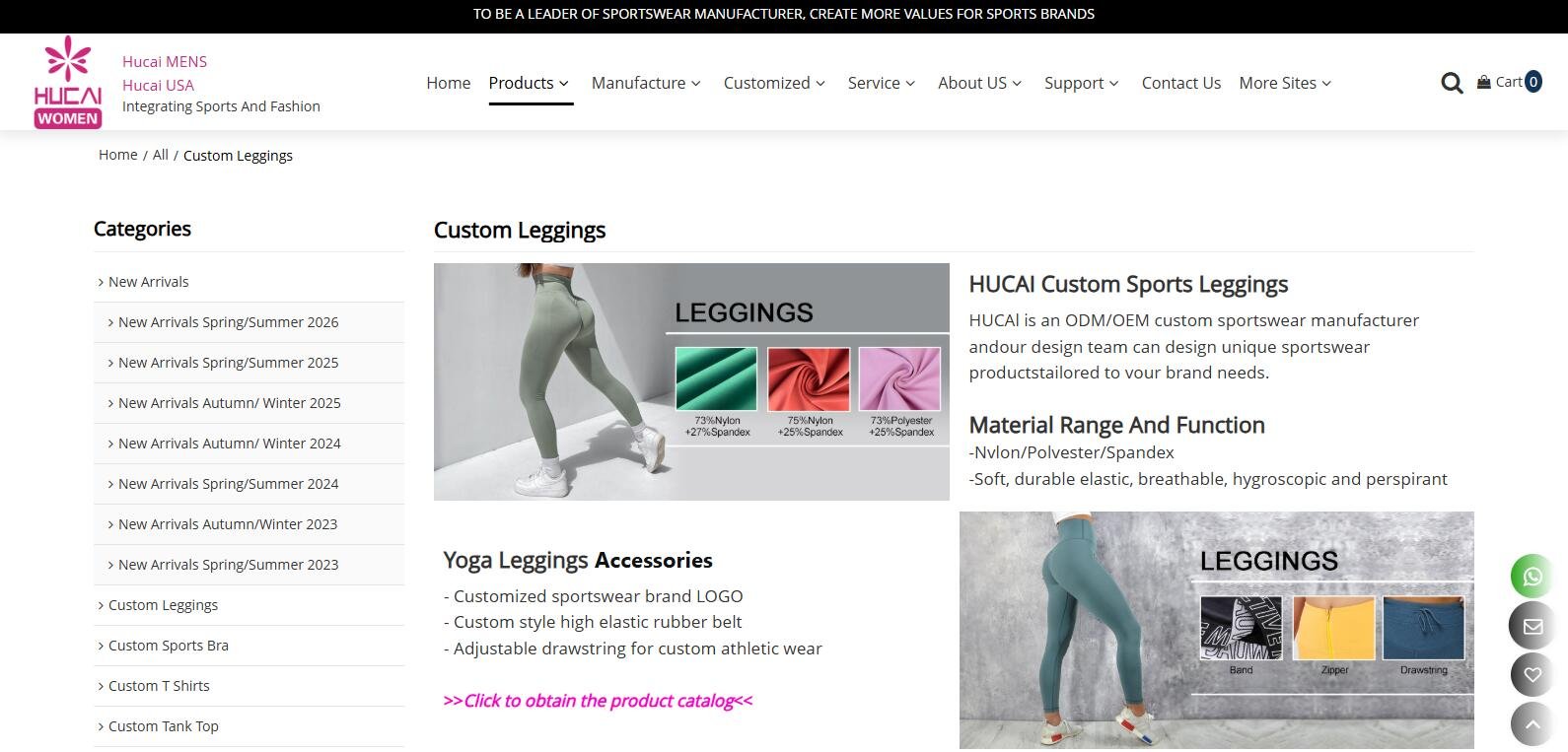
Best for: Cost-efficient bulk production.
4. Affix Apparel – Custom Activewear Supplier
Best for: Multi-SKU private label programs.
5. Argus Apparel – USA-Based Manufacturer
Best for: Domestic USA-based scaling.
Comparison Table
| Factory | Strength | Best Use Case |
|---|---|---|
| Fukigymwear | Pattern + QC systems | Growing performance brands |
| Alanic | Large capacity | Global expansion |
| Hucai Sportswear | Cost efficiency | Bulk programs |
| Affix Apparel | Multi-SKU control | Private label brands |
| Argus Apparel | Domestic production | USA-based brands |
How to Decide If Your Brand Is Ready to Scale
You are ready if:
- Fit is stable with low return rates
- Fabric specs are fully documented
- Styles can be reordered consistently
- Supplier has volume experience
👉 If not, fix systems before scaling.
FAQs
Q: When should brands scale leggings production?
A: After fit and fabric consistency are proven across at least one reorder.
Q: What breaks first at scale?
A: Fabric variation and sizing inconsistency.
Q: Does scaling reduce cost?
A: Only when systems are properly implemented.
Work With Fukigymwear
If you're preparing to scale production:
👉 Fukigymwear helps brands transition from small batches to stable, scalable systems.
We focus on:
- Production systems
- Repeatable quality
- Reliable scaling
👉 Scale your leggings production the right way.
